{ Week 10 } Other Scheme - Detour


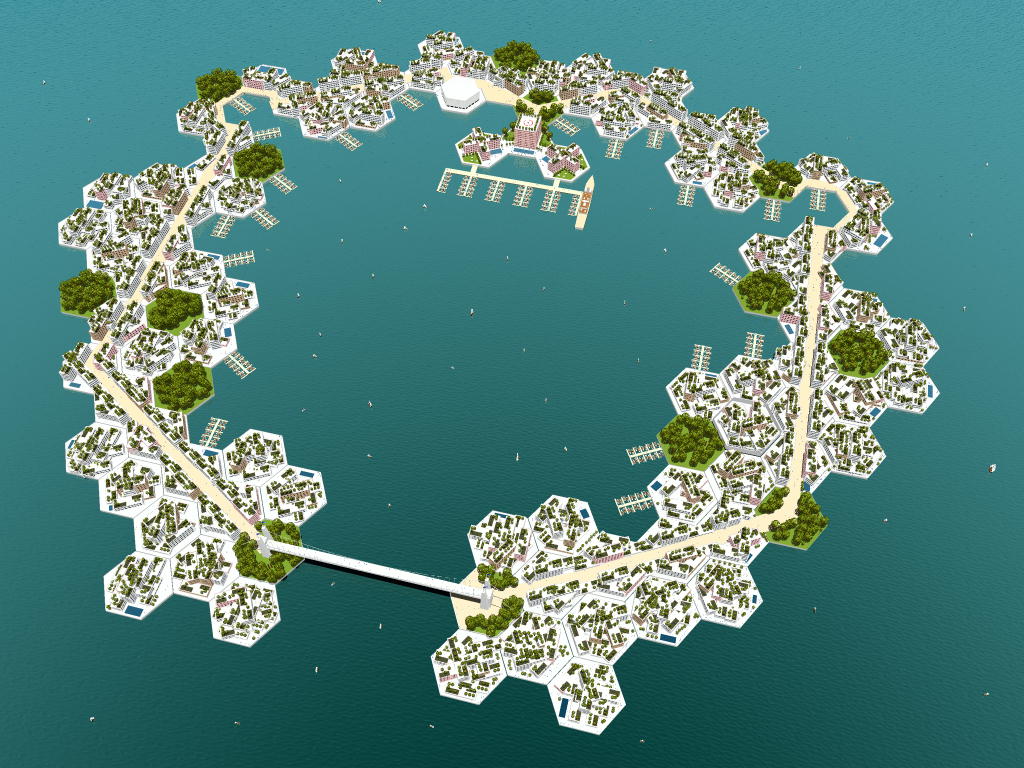
I was trying to push the boundaries of what was possible. I liked the leaf design because it physically divided up the rotation of harvesting plants and the gaps could possibly be loading docks where smaller ships could come in to get more food. There was lots of potential which I brought back to my original design.

This detour also helped me understand better especially about circulation. It was difficult to move from one leaf to another. By stepping out, lift placement was difficult. Sun access was also an issue. 

Jane and others also noted how it was important to make sure the design would float and that it looked like it had direction.

I took all these opportunities and issues, pared back the design and worked with something more cohesive and workable in the end. Thank you Jane. It was hard to let go but I did it :)

{ Week 10} Common Areas

http://www.incat.com.au/domino/incat/incatweb.nsf/0/2A5A8E42B59C55D4CA2573A100022BD6?OpenDocument

Dining facilities on a HSV. Definitely can do better than this.

{ Week 10 } Bridge Size

http://www.incat.com.au/domino/incat/incatweb.nsf/0/0B6DB2B0ACE13430CA25743300018A56?OpenDocument

Smaller than I thought it would have to be. Good. This is for the:


File Number:0610375ETH.jpg
Name:HSV 2 Swift
Vessel Type:98 Metre Wave Piercing Catamaran
Hull Number:061
Operator:Military Sealift Command
Region:Global
Route/Location:Global
Description:Bridge layour aboard HSX 2 Swift
Photographer:Daniel Ferro

{ Week 10 } Smoother Ride

http://upload.wikimedia.org/wikipedia/commons/e/e0/T-foil.PNG

The T-foil is used in combination with two transom mounted trim tabs providing ride control forces equivalent to a pair of keel mounted T-foils ensuring a smooth ride in heavy seas. The retractable T-foil is used only when it is needed hence there is less drag to slow the ship, with resultant savings in fuel and less chance of the foil striking a submerged object.

http://www.incat.com.au/domino/incat/incatweb.nsf/v-title/Passenger%20Comfort?OpenDocument

{ Week 10 } Researching Structural Design of Base


The main role of the centre bow is to act as a shock absorber for oncoming seas. Normally the centre bow is above the design waterline. As the ship pitches into waves, the buoyancy force provided by the immersion of the centre bow causes the vessel to reduce its pitching motion by acting as a huge damping system.

The centre bow is the first part of the ship that encounters waves, passengers are therefore cushioned from damaging accelerations by the action of the bow engaging large waves.
The result – a smoother ride.


http://www.incat.com.au/domino/incat/incatweb.nsf/v-title/Centre%20Bow?OpenDocument

{ Week 10 } Research Backing Up Basis of Project: Carrying Capacity, Speed, Distance

Carrying Capacity and Speed
The chartered vessels quickly lived up to their billing. Normal transit for a Marine battalion from Okinawa, Japan to South Korea aboard ferry or amphibious shipping is about 2-3 days, and moving it by air would take 14-17 “lifts” from C-17 aircraft, a process that might require several trips depending on how many planes were available. The same deployment could be carried out by Austal’s chartered WestPac Express catamaran in 24-30 hours; which is to say, at about half the time of conventional naval options, at about 25% of the cost of using airlift. 


Operations
saw extensive Army use in operations Enduring Freedom and Iraqi Freedom, as well as supporting operations in the Pacific, Atlantic, Mediterranean, Horn of Africa, Persian Gulf and Southeast Asia. In one operation, Spearhead moved the 101st Airborne Division’s military police and their equipment from Djibouti, Africa to Kuwait in the Persian Gulf. The fast catamaran made the 2,000 mile trip in 2.5 days. Its naval LSV predecessor would have needed 10 days to make the voyage, and would only have carried the equipment, forcing the troops to fly separately.

http://www.defenseindustrydaily.com/jhsv-fast-catamaran-transport-program-moves-forward-updated-01535/

Known as Wave Piercing Catamarans
Can travel anywhere. less than 6 day Atlantic crossing to the United Kingdom. After servicing in Gulf waters, she crossed the Indian Ocean and proceeded back across the Pacific Ocean to the US West Coast.


http://www.incat.com.au/domino/incat/incatweb.nsf/v-title/Joint%20Venture%20HSV-X1?OpenDocument

{ Week 10 } Wave Piercing Catamarans and Trimarans


  • Capable of easy refitting to reduce long shipyard periods.
  • Jet propulsion power does not need require propellers or a  rudder for steering.
  • Can maneuver in 3m deep water. Capable of accessing smaller ports commonly found in developing countries.
  • Can cruise 77km/h and up to 122km/h with wind assistance.
  • Tsunami relief in North Sumatra.
  • Seen ships 30 days at sea - refuelled by other ships. 
  • Crew Rotation every three months.
  • Australian Designs and Companies support Australian Aid Initiative.
  • Seen boats that run purely on solar power
Reference: http://www.austal.com/en/

{ Week 10 } Jobs

Jobs People Need to Do
  • Fish feeding
  • Plant seeding and harvesting
  • Mechanical filter clean
  • Water testing
  • Water top ups, unless autofill valve is connected

http://www.paulnock.net

{ Week 9 } Progress: Blocking In Spaces


Playing around with how much can be produced with all systems supporting each other.


Playing around with floor plans.

Starting to think it looks too fat and not nimble enough. Might strip some fat.

{ Week 9 } What Fish to Harvest

  • Barramundi
  • Perch
  • Sleepy Cod
  • Perch
  • Parrotfish
Australian natives work well in this system. If all fish were growing at different rates, we can fit more in and harvest continuously. 

I can probably hold 1000-2000 fish from my current calculations. It isn't a lot but I think it will still be so much better than what would be available. 

{ Week 9 } What Food To Produce

Decisions of What to Produce Are Dependant on:

1. Cultural Dietary Requirements
2. How long we stay there for.
3. How long it takes to get there.
3. Little refrigeration requirements for storage.
4. Keep long enough for loading and distribution
5. Speed of growth for rotation of crops.

Crops that could be used include:

Beans: 4 weeks
Radishes: 3 weeks
Lettuce: 4 weeks
Spinach: 4 weeks
Onions: 4 weeks
Leafy Asian Greens: 4-6 weeks
Wombok: 7 weeks
Carrots: 6-10weeks
Potato: 12 weeks to 20 weeks depending on variety.

I think Chau can plant slower growing plants because of the size of her ship. Mine would work better with faster growing crops that can provide quick and constant turnover.

Keep in mind that these will grow faster in an aquaponics/ETFE environment because it's such a healthy system.

Reference: http://www.annettemcfarlane.com/vegetable.htm

{ Week 9 } Feeding Fish Option: Worm Farm


Thinking about managing food waste from crew. Worms can eat food scraps, reducing waste, which can then feed the fish.

Image: http://www.wtcc.sa.gov.au/webdata/resources/images/worms_soil.jpg

{ Week 9 } Feeding Fish Option: Fish Pellets

Fish Pellets

Probably the easiest and most realistic option.


There are formulas that can be used to calculate exactly how much food to give your fish per day.  The formulas are grams of food per grams of fish weight.  To exercise the formula correctly requires that a number of fish be caught and weighed on a regular basis, establish an average fish weight, then  calculate the correct amount to feed.


Possible to purchase an auto fish feeder device to give a regulated amount of feed per day. 


Image: gambar pellet ikan[3].jpg
Reference: http://www.aquaponics.net.au/prod18.htm

{ Week 9 } Feeding Fish Option: Grow Black Soldier Fly Larvae

With Murray Hallam

Yum! Not. 

High Capacity production.

5-8 day life. They consume vegetables. Can recycle food scraps from people's meals to reduce waste. They are clean. Can be frozen but I don't want to have to freeze too much stuff. I want to keep energy use down.

{ Week 9 } Model Ideas


Exploring!!!

{ Week 9 } Other Forms


This is the montenegro apartments by BIG. Makes me think about the possibilities of organic curves.

{ Week 9 } Steps Ideas

Did some modelling. Still Thinking about form.


Thinking about how to step the "paddies" and the relationship it has with the accommodation spaces underneath.

{ Week 9 } Arrangements


Stepped Rice Paddy Form Presents opportunities of light.


Then thought about vertical planting as well.


I want spaces to work hard. Plants will need light but so will people. Accommodation will sit directly under food production spaces so that people can still have light and sir. The window will hence also open out onto the planting and have "ocean" views.


Walking areas and Semi-Private Spaces can extend beyond the food production area to create healthy vibrant spaces for people to walk, talk, relax, eat, read, work, etc.

{ Week 9 } Initial Form


Section


Alternative Form and Idea

I imagined that the structure would look like a leaf or something close to a ship for mobility but I noticed Chau is doing something similar. I am considering changing the shape of the shell. I think it will be nice if all three of us showed very different designs. So back to the drawing board. Should be ok.

{ Week 8 } Cont. Opposite Thoughts


Sinking Ship!
What if I sink the gardens into the boat. What opportunities would present itself? How about the idea of capturing wind energy and collecting water that exists in the air already? Will see.

{ Week 8 } Initial Thoughts

In section. Folding Shell.

Form
Should be aerodynamic for movement

Wind Advantage
Form should catch the wind to convert into electricity for: lighting, communications, etc.

Rising Heat
Can be captured for electricity


Form
Core as a community space. Edges as personal spaces.


Alternative Arrangements
Creating sun opportunities. Lowers energy cost. Not sure if the air to spaces ratio is good enough?


Open End
How about creating a closer relationship between the community space to the water, situating it between the water and the land. Like a beach???? There are notions about how we would normally plan a city.

{ Week 8 } Rice Intensification and Process


Australia boasts the most efficient rice production system in the world. We create the highest yields of medium grain rice, using least amount of water (50% less). I did get this information from Sunrice though.

Another efficient rice method is SRI - system of rice intensification. Currently, we are teaching women and men in developing countries to use this method to increase yields. It is a dry method as opposed to the wet one.

http://www.oxfam.org.au/explore/health/food-and-nutrition/the-rice-revolution

{ Week 8 } Ship Form

Source: Rice Field in Ha Giang, http://www.vnphotoguide.com/alpha/index.php?page_file=gallery&sub_page_file=enlarger&image_id=161

I will base the form of my mobile architecture on rice fields!

{ Week 8 } Aquaponics Ratios

Pilot Commercial Aquaponics at Challenger Institute of Technology (Fremantle, WA)

Say a 5000L tank will require:
- a vortex filter system
- 1000L sump tank with submersible pump
- 16 x 6m NFT channel

Shade cloth for:
- wind
- frost
- birds

Fish Ratio
- 350 Rainbow Trout
- 35kg per cubic metre

Hallam's Aquaponics

This system uses 1 Fish : 10L water : 10 L Food  (As long as fish are growing at different rates).
So 100 Fish: 1000L of water : 1000L of food can be produced.

In another video showing a commercial crop, 1000 Lettuce can be harvested every week with 4000 Lettuce growing. To achieve this rotation, it takes 2hrs a day to harvest but I couldn't find out how many people this required.

Other Systems
I also found another ratio: 1 Million Pounds of Food, 3 acres, 10000 Fish, 500 compost

{ Week 8 } Main Components

http://aquaponicssystemplans.com/wp-content/uploads/2011/07/Commercial-Aquaponics.jpg
  • Fish tank
  • Grow beds
  • Water pump
  • Aeration pump
  • Biofiltration
  • Mechanical Filtration
  • Plumbing for irrigation and drainage
  • For media based systems, medium is needed.
  • Fish and plants (seeds)
  • Water
http://www.aquaponics.com.au

{ Week 8 } How Plants Receive Nutrients from Fish


My dad started a small patch of tomatoes a couple of years back using a similar technique to the video. Very primitive but similar ideas of using the tank of fish at the bottom as opposed to NFT which uses a nutrient film flowing into channels. Wish I had looked more closely at what he was doing at the time...

Information below by Dr Wilson Lennard, Phd Applied Biology, Australia, studies aquaponics
http://www.ecofilms.com.au/2011/01/08/dr-wilson-lennard-on-commercial-aquaponics/


Natural Provider of Nutrients
Phosphorous, Nitrogen and Micro-minerals are provided by the fish waste as opposed to using Seasol or other fertiliser.

Additions
This system has iron deficiencies so you need to add this especially in the first year.
Calcium hydroxide and Potassium carbonate is also added. This also balances pH.
Sodium bicarbonate is a cheap option but sodium is not good for the system.

{ Week 8 } Hydro/Aqua-ponics Research


Benefits of hydroponics.

  • No soil is needed
  • The water stays in the system and can be reused - thus, lower water costs
  • It is possible to control the nutrition levels in their entirety - thus, lower nutrition costs
  • No nutrition pollution is released into the environment because of the controlled system
  • Stable and high yields
  • Pests and diseases are easier to get rid of than in soil because of the container's mobility
Benefits of Aquaponics
  • Yields 25-75% Faster

{ Week 8 } Circle of life

Mimic natures cycles.

Produce an ecosystem?

For example, produce seaweed for consumption and use as fish food to harvest fish. Fish waste can be reused for seaweed production.

But what about plankton and other things you can't get? Maybe it should be open for any fish to come along

This is hard. Time to look at food production soon

{ Week 8 } Ship Basics

SHIPWEIGHT 9 with crack !!!

When designing and building a vessel, weight and center of gravity are key parameters for successful performance. Speed, strength, deadweight, stability and seakeeping are all parameters crucially dependent on the weight and center of gravity. To ensure and maintain these parameters a reliable estimation of weight and center of gravity followed by an organized tracking and monitoring activity is essential.

{ Week 7 } Experiential Thoughts


Gehry, Art Gallery of Ontario
http://wvs.topleftpixel.com/photos/2008/11/AGO_opening_ship-ribs_tall_02.jpg

{ Week 7 } Inspiring Ship Engineering: Catamarans

Benefits of a double hull
Faster than monohulls as there is less drag in the water.
Resists overturning better

Cons
Slower to turn than monohulls due to drag
Can capsize


http://www.superyachttimes.com/articles/Image/Companies/Sabdes/2009-01-50m-Cat/Sabdes-Cat-50-big.jpg


This is a high speed military catamaran.
http://www.ratedorhated.com/ratings/huge_catamaran_b.jpg


http://www.liveyachting.com/wp-content/uploads/2009/06/60m-motor-catamaran.jpg

Basic Catamaran


Hyodroairy or Pontoon Type

SWATH Type

{ Week 7 } Artistic Inspiration


Tim Hawkinson, Mobius Ship, 2006, wood, plastic, Plexiglas, rope, staples, string, twist ties, glue
http://cdnimg.visualizeus.com/thumbs/bf/96/sculpture,art,architecture,creativity-bf96b23d7bf5d9670d9d7a8b5586a242_h.jpg


Daniel Widrig
http://cdnimg.visualizeus.com/thumbs/8e/0e/architecture,art,daniel,widrig,design,digital,digital,design-8e0eecdb4248b7eb329bf8aacbb827a7_h.jpg


Daniel Widrig
http://cdnimg.visualizeus.com/thumbs/5c/f6/architecture,art,daniel,widrig,design,digital,design,digital,fabrication-5cf6f90925f403c462d9b3dc4d1cc75c_h.jpg

{ Week 6 } Presentation


PANEL 1
Took forever to understand what panel one should be about. Did so many iterations! We ended up taking four issues parliament is concerned about and highlighted the key problems that needed to be addressed. We wanted to deal with:
1. Increasing Natural Disasters
2. New Resilient Infrastructure
3. Food Supply
4. Food Waste

We used before and after pictures to show problem and goals. We worked really hard at drawing these up and Chau even bought a toy train so we could take a photo showing how we can use mobile structures to bring food to people.


PANEL 2
Visually illustrates how the mobile structure fits into existing aid response infrastructure and how it it functions and reacts on a big global scale to a more local scale.


PANEL 3
Shows services we will provide and also talks about identity and presence.

{ Week 6 } Presence


We are playing around with ideas about creating an identity that would be recognisable as being Australia’s Capital and Parliament. This is especially important because we are not physically located in Australia’s capital city. I think this can really open up opportunities about direct, abstract and poetic conveyances of what makes Canberra a capital and what makes us Australian. There is a lovely relationship between the mobile structure’s activity of giving and providing and Australia’s values about camaraderie and generosity.

1. Light. Form.
Presence and Identity should begin with the structure being seen in the distance. Ideas include it being seen as a beacon of hope. This can perhaps be conveyed poetically using light. Perhaps it can be recognisable using form.

2. Planning and Function
Floor plans and functions can relate to Parliament’s spirit of working together to achieve goals of equity, justice and Australian pride. Ideas of mateship can shine through by designing the ship to function together well and efficiently. Perhaps this parliament relationship can be a bit more literal, taking inspiration from the curved forms of parliament house to form the basic floor plans of the mobile structure.


{ Week 5 } Group Meeting

Agenda
Finish draft board 1, 2 for tomorrows tutorial


Topics: Mobile [ Summary ]


. Natural Disasters
- Mitigation of Natural Disasters
- Prevention - Structural - People
- Protection - Infrastructure
- Recovery - Immediate - Health - Rebuilding Infrastructure
- Long Term - Health - Rebuilding Community
- Rebuilding Livelihood


. Transport - Congestion - Environmental Impact - Health
- Carbon Emission
- Underground Transport [ Solution ]
- Communication - More Efficient Use of Roads
- More Roads - Less Green Space

. Environment - Carbon Tax
- Overconsumption - Waste - Carbon Emission - Climate Change
- Actions - Natural Disasters
- Economy Downfall - Health

. Food
- Waste - Landfill - Carbon Emission
- Production Waste - Transport - Oil
- Carbon Emission
- Congestion
- Distribution
- Accessible
- Primary Suppliers - Secondary Middle Man [Distributer] - Consumption
- Transport


. Communication
- Meeting in Person - Inefficient use of Resources [Debate, Campaigning]
- Politician Communication
- Public - Movable Pavilion
- Each Other
- Other Countries
. Economy - Alternative Self Sufficient Markets


Today we discussed what exactly will be in our boards.
We went through our notebooks and blogs to simplify our thoughts, trying to summarise our thoughts from the last 5 weeks.

{ Week 5 } Chance to Grow?

What are the system’s possibilities for growth?

Can there be many smaller mobile structures that can function independently but can come together for coordinating larger operations?

Can the mobile structures continue to grow as changes and new needs must be met?

Perhaps producing fruit, vegetables and wheat/rice, etc is not enough. Maybe there is a possibility for extending this food network into the water ie. Fishing catchments. Pretty convenient since we are in the water anyway.


http://forums.civfanatics.com/showthread.php?t=382212

This is from a game website. It makes me think about possibilities about having several mobile parts that could possibly come together to perform complex functions but can still function independently. Possibly this could also talk about creating communities and ideas about flexibility to cater for different aid responses based on assessing the needs of the people.